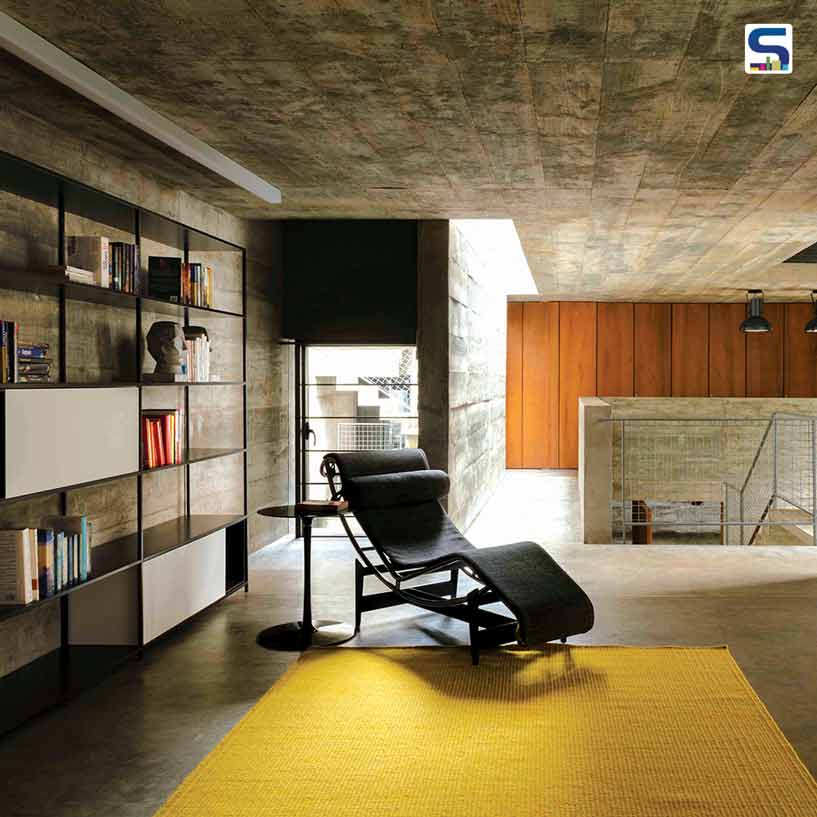
The house, designed for a migrant businessman, his wife, and their three daughters, is located within the dense urban fabric of Chennai, a metropolis in southern India. The tight and narrow site, measuring 41 × 102 feet (12.5 × 31 metres), is open only at one corner, which connects it to a cul-de-sac. Bounded by houses on three sides and a high-rise apartment complex along its longer edge, the site offered little scope for natural light and ventilation and was deprived of much of its privacy.
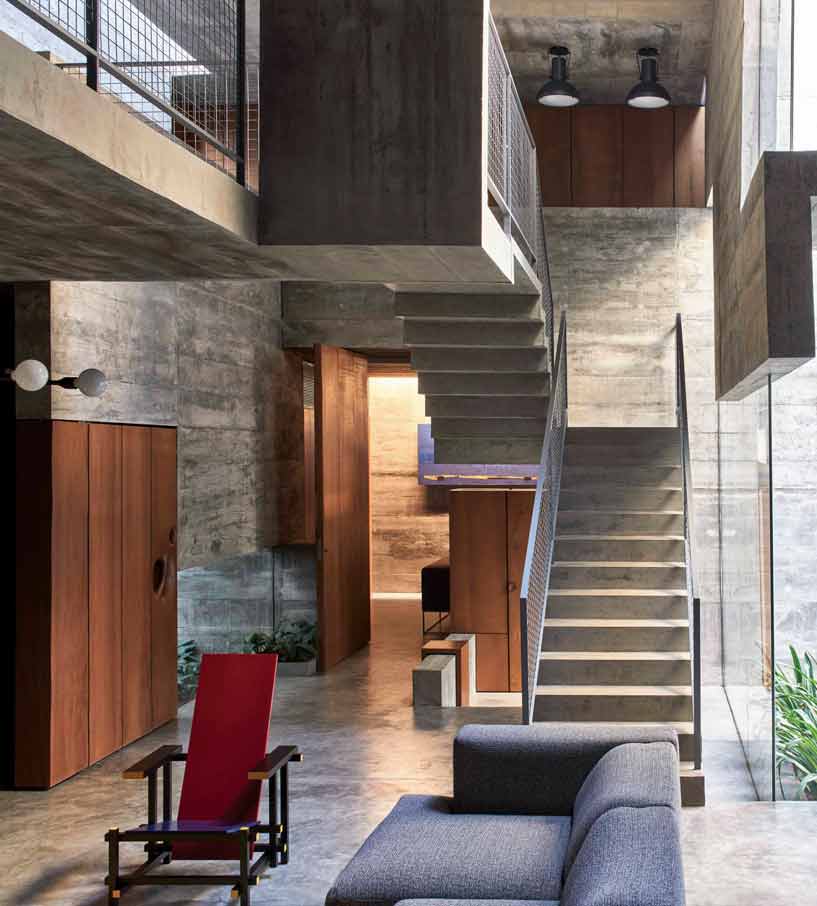
" With the ground floor almost completely free of columns, the structure is mostly suspended from above and treated as a continuous concrete plane in three dimensions, enclosing and connecting the house in a seamless continuum of space."
DESIGN IDEA
Taking advantage of the development authorities’ bylaw that allows wall-to-wall construction, the house extends to the edges of the site on three sides to maximize usable f loor area and utilizes the otherwise residual margin space. A concrete plane envelopes the periphery, forming a monolithic shell that shields its contents from the outside world. It is only upon entering that the plane unfolds to reveal its hollowed center.
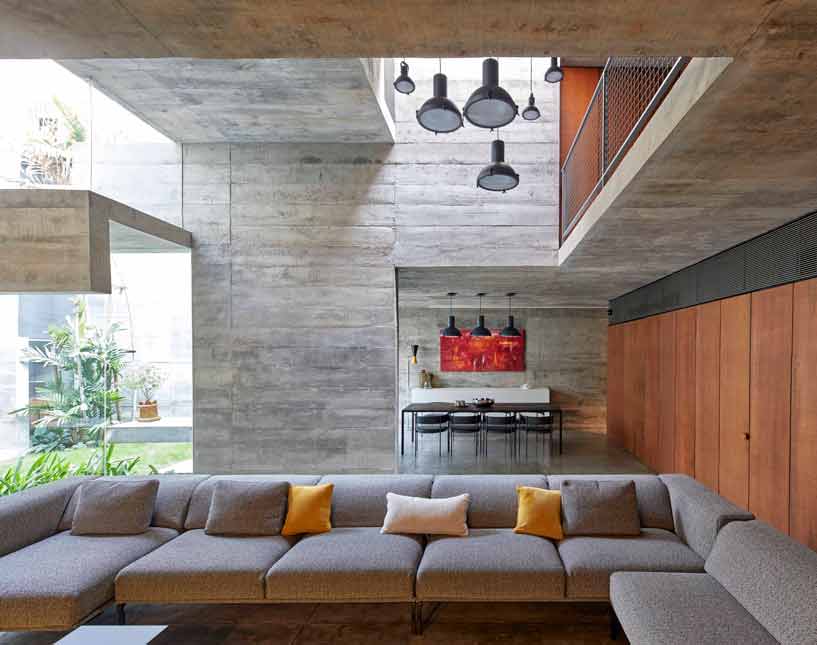
Borrowing from the idea of the traditional Indian courtyard, large voids are carved out from within, bringing in ample light, air, and greenery. The largest of these courts is positioned at the heart of the house and seamlessly extends indoors at ground level—an open, f lexible floor plate for the home’s living areas. It both segregates and connects the formal living areas with the private ones that flank it, forming the hub of family life where activities converge.
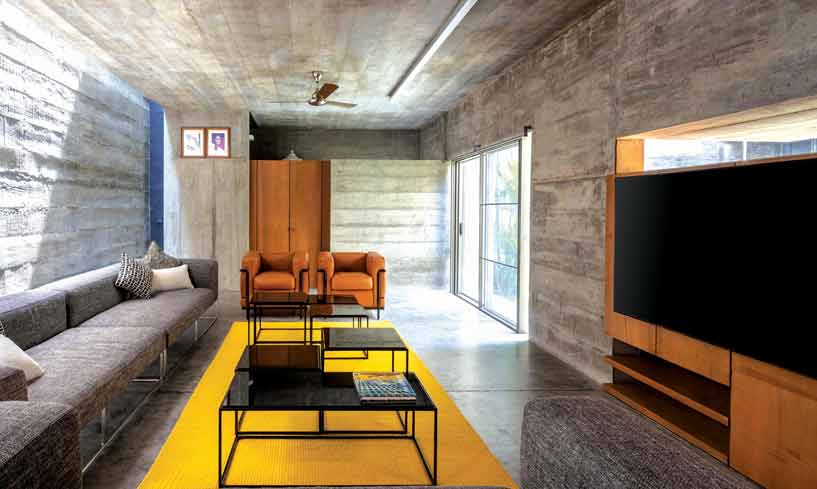
Smaller courts are placed along both axes of this central court, visually connecting the entire length and width of the site. Private areas are lifted to the upper levels of the house, opening further into smaller secondary courtyards and, through carefully positioned windows, into the margins of the neighboring context.
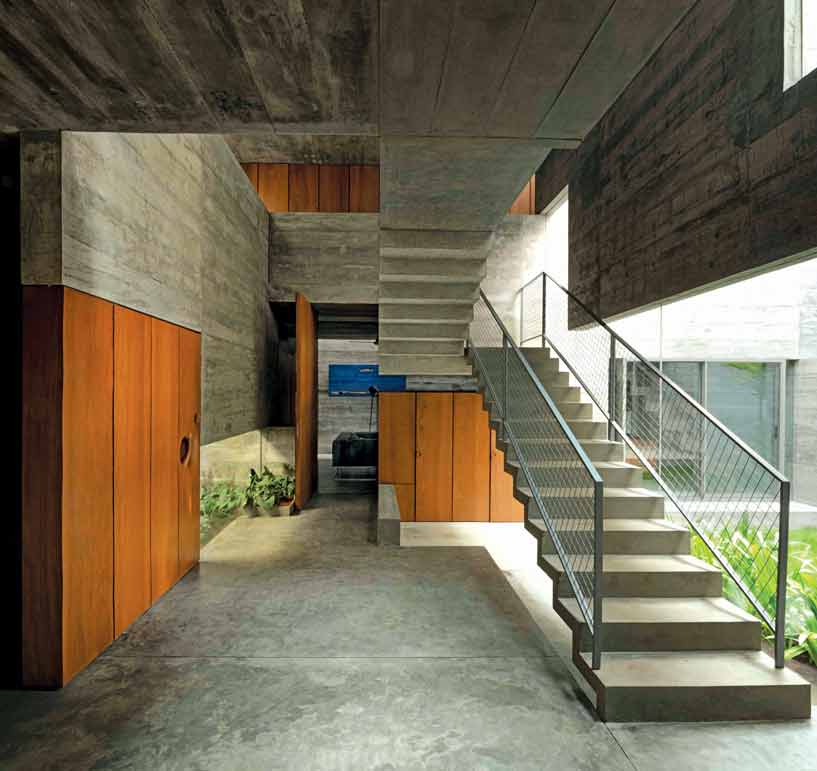
The staircase, walls, and slabs are considered in capacities beyond their basic structural function. With the ground floor almost completely free of columns, the structure is mostly suspended from above and treated as a continuous concrete plane in three dimensions, enclosing and connecting the house in a seamless continuum of space.
AR GURJIT SINGH MATHAROO
Principal Architect, Matharoo Associates, Ahmedabad

Matharoo Associates is a startup firm that began operations in Ahmedabad, India in 1992. In 2013, Gurjit Singh Matharoo Principal Architect was Conferred an International Fellow of the Royal Institute of British Architects, only the third Indian after Architects Charles Correa and Professor B. V. Doshi to be inducted into the fellowship. The diverse range of projects have brought the firm International and Domestic recognition, and they were winners of the 2011 International Architecture Award by the Chicago Athenaeum, the 2010 Architectural Review Best House Award and the 2009 AR Emerging Architecture Award, to name a few. They were also invited participants at the International Architecture Biennale at Venice 2016 and 2018 and Chile in 2017. Gurjit was chair of Architectural design at his Alma Mater CEPT from 2016 – 2019 where he has been visiting faculty since 1992. He is passionate about automobile design and often rides his naked Ducati to work.
PROJECT DETAILS
Project: Cut Bend Fold Play
Location: Chennai, Tamil Nadu, India 2018
Project Team: Gurjit Singh Matharoo (Principal Architect),Trisha Patel (Project Architect), Aliza Mehnaz (Architect), Sadar Bhadari (Intern)
Structural Design: Rushabh Consultants
Interior Design: Matharoo Associates Landscape Design: Matharoo Associates
Electrical Consultant: Jit Engineering Services Ltd
HVAC Consultant : Pankaj Dhankar and Associates
Plumbing Consultant: Aqua Utility Designs and Management Pvt. Ltd
General Contractor: J K Constructions
Site Area: 3,980 ft2 (370 m2)
Total Floor Area: 5,800 ft2 (540 m2)