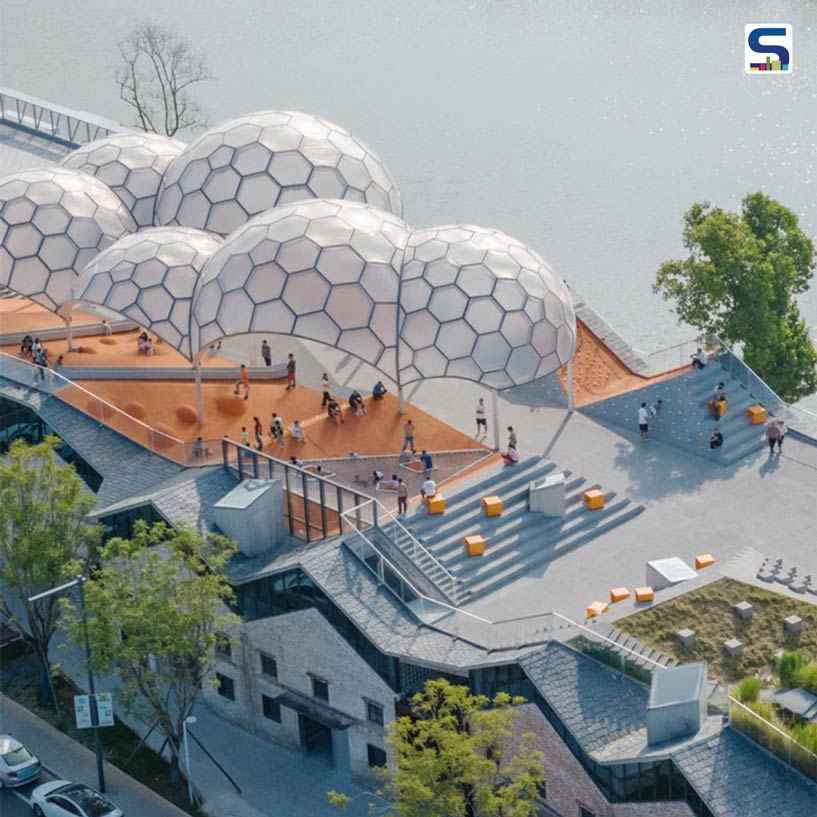
Along the banks of the Huadi River in Foshan’s Dali Town, within the Nanhai District of China’s Pearl River Delta, a row of abandoned grain storage warehouses have been transformed into a compelling work of adaptive architecture. Completed in 2025 by Guangzhou-based practice Atelier cnS, the Yongping Warehouse Renovation, also known as A Wisp of Cloud over the Huadi River, is a project that rewards attention without demanding it. Know more about it on SURFACES REPORTER (SR).
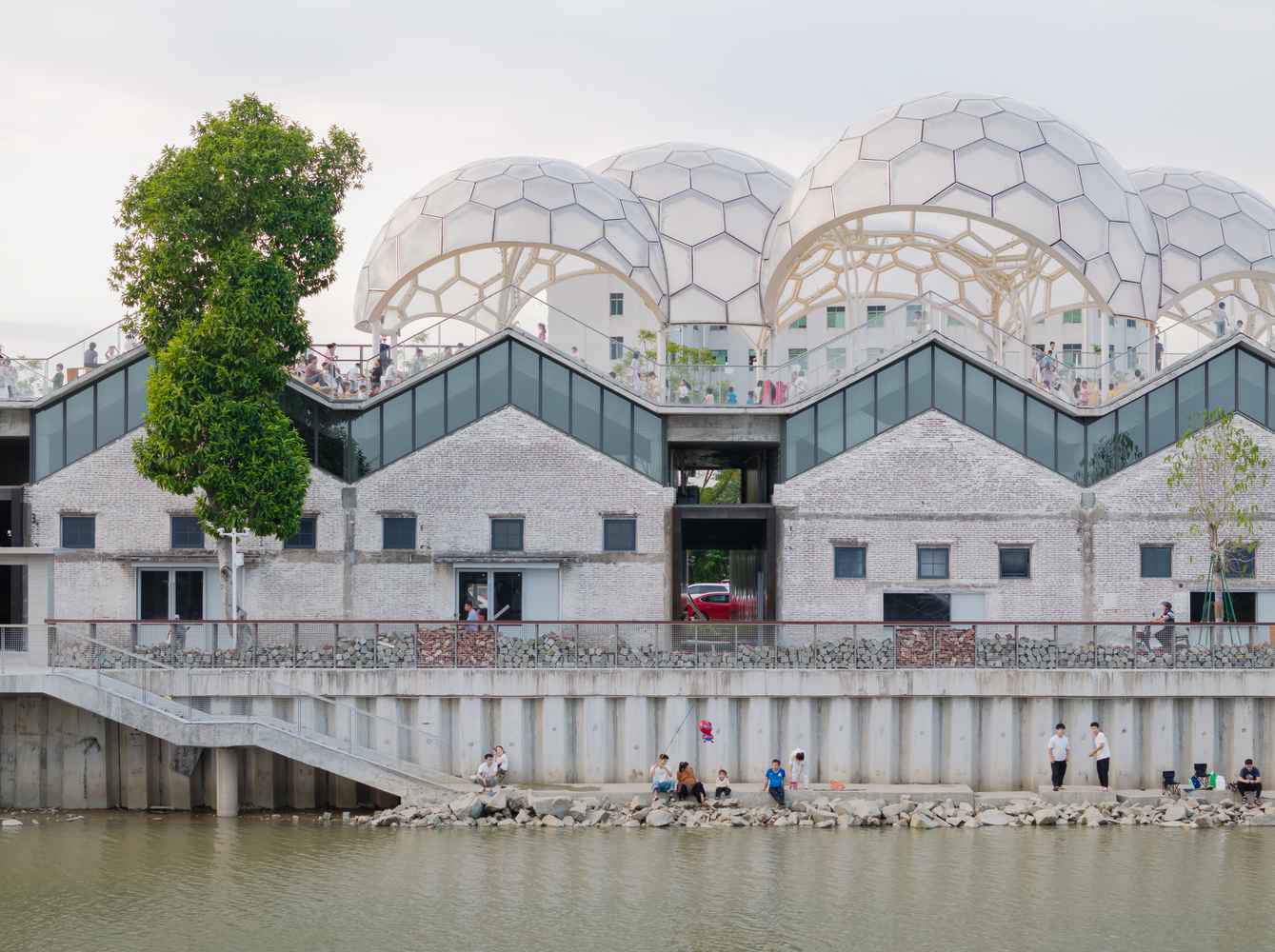
Given the site’s narrow footprint, the architects made a decisive move of rather than expanding horizontally, they pushed the public programme upward, placing a landscaped rooftop park above the commercial spaces at ground level.
The district is in the middle of a broader transition, where it is gradually moving away from its identity as an industrial enclave toward being more publicly oriented and livable. The warehouses, which once lined the riverfront in a state of disuse and neglect, offered little architectural promise. However, Atelier cnS approached the site without hesitation, and the result is a renovation that speaks quietly but with considerable conviction.
_11zon.jpg)
Crowning the roofline is the project’s most visually arresting feature comprising a series of translucent, domed canopy structures assembled from hexagonal frames, clustered across the top of the building like a gathering of clouds.
The project covers a total area of 4,311 sqm. Converting a commercial renovation into a freely accessible rooftop park, in a district actively shedding its industrial past, represents a genuine act of civic generosity. Given the site’s narrow footprint, the architects made a decisive move of rather than expanding horizontally, they pushed the public programme upward, placing a landscaped rooftop park above the commercial spaces at ground level. What distinguishes Yongping is the care with which the transition between levels has been handled. Rather than sealing or infilling the gaps between the original warehouse blocks, the architects preserved and widened these voids into passageways. Moving through the building, visitors catch carefully framed glimpses of the river between walls before the full panorama opens up at the rooftop.
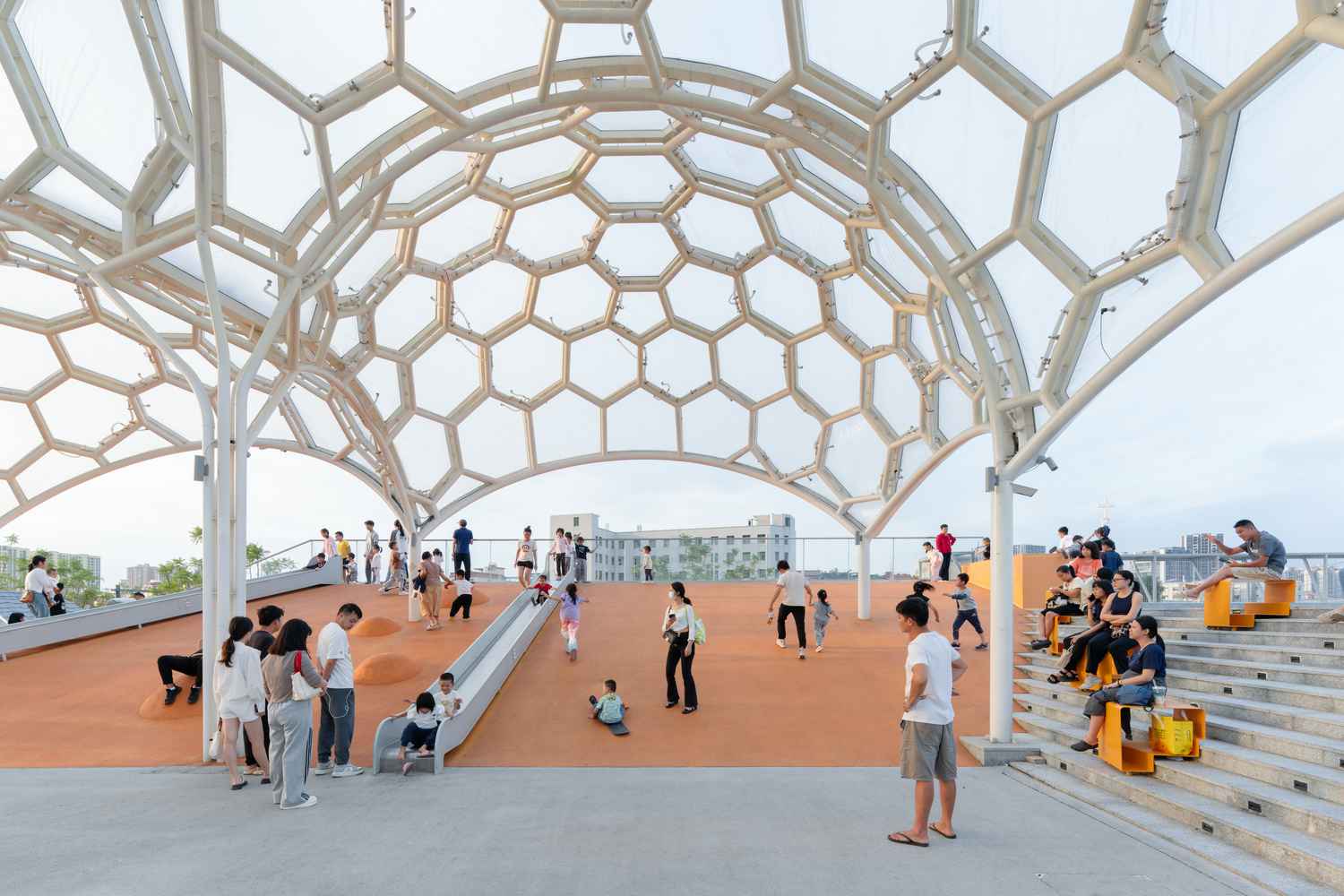
The domes diffuse light softly across the rooftop, casting shade without obstructing views of the river or the sky.
Crowning the roofline is the project’s most visually arresting feature comprising a series of translucent, domed canopy structures assembled from hexagonal frames, clustered across the top of the building like a gathering of clouds. It is from these structures that the project’s poetic subtitle derives, and the name proves entirely apt. The domes diffuse light softly across the rooftop, casting shade without obstructing views of the river or the sky. Rather than enclosing or overwhelming the space, they define zones for sitting, movement and play with a lightness that makes them feel less like built interventions and more like natural phenomena.
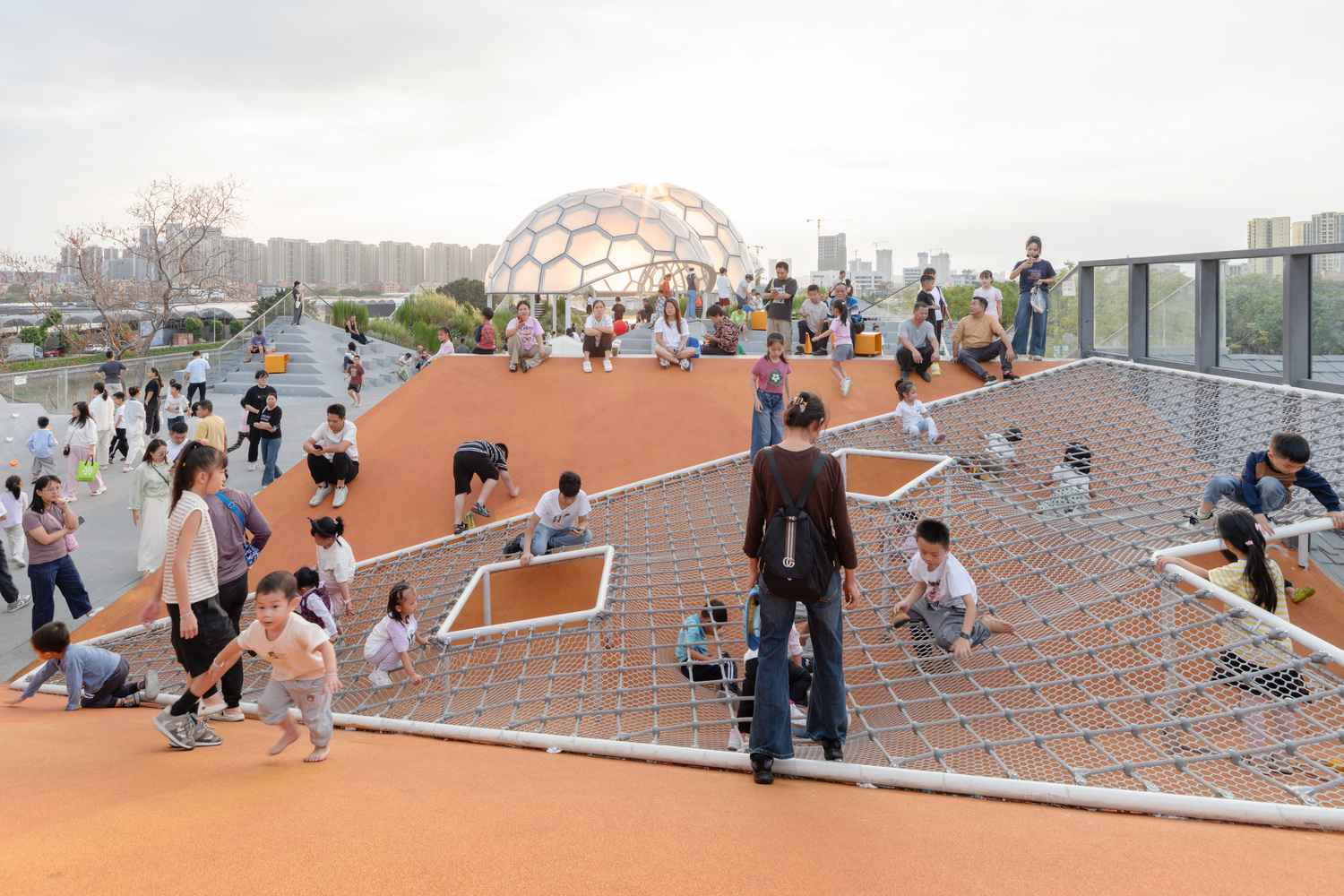
Rather than enclosing or overwhelming the space, they define zones for sitting, movement and play with a lightness that makes them feel less like built interventions and more like natural phenomena.
The rooftop itself is sculpted into a landscape of slopes, steps and play surfaces whose forms consciously echo the pitched profiles of the original warehouse roofs beneath. The old buildings are not erased or disguised, instead they remain structurally and spatially present with their rhythm and proportions continuing to govern the organisation of the new design. This approach stands in deliberate contrast to the type of renovation that reduces the original structure to a mere container for an entirely new architectural statement.
Image credit: Siming Wu